
Zoning systems
How zone panels, motorized dampers, the bypass damper, and the discharge air sensor negotiate every time a zone calls — and why zoning bolted onto single-stage equipment generates so many service calls.
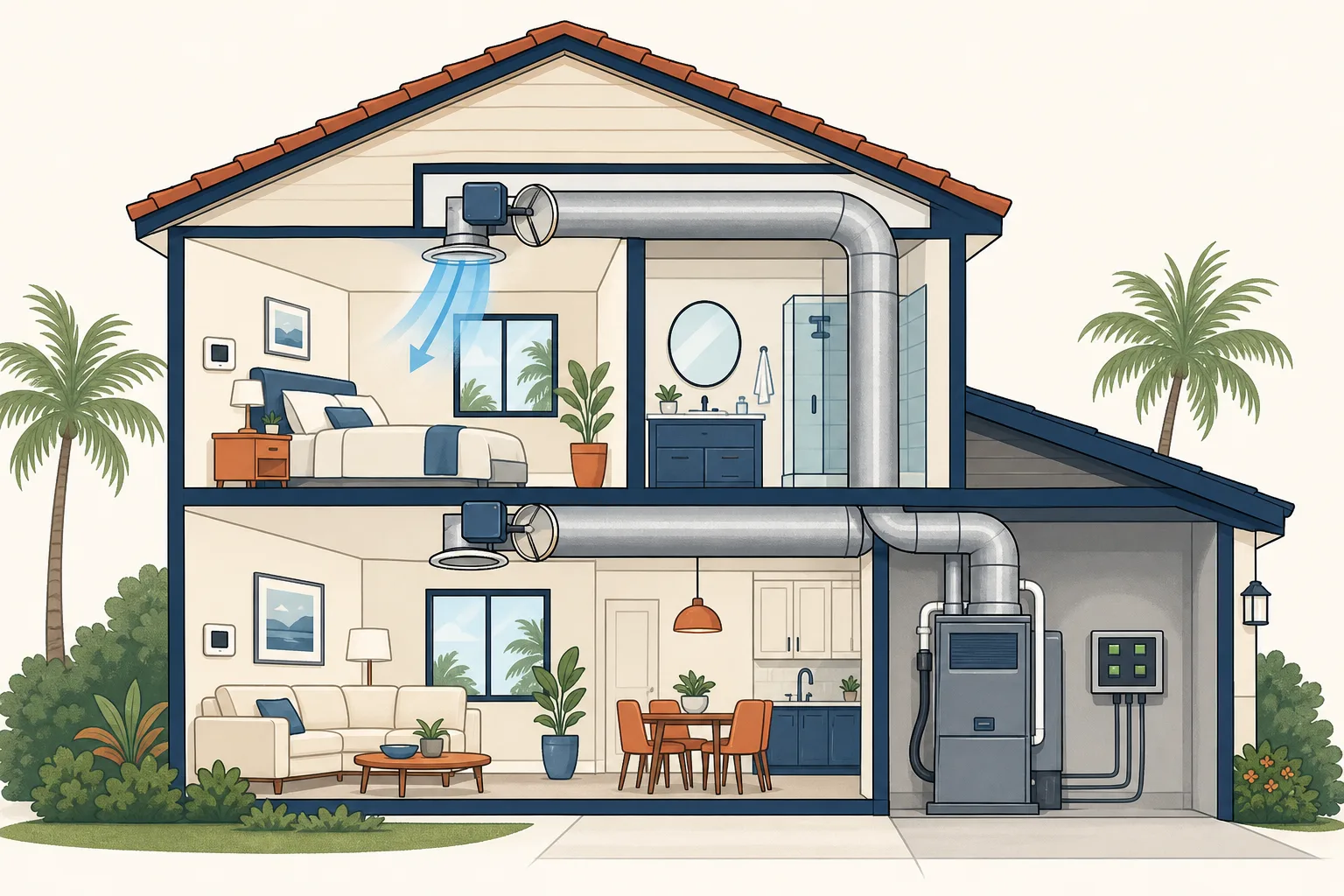
Zoning systems — click diagram to enlarge
For homeowners
Zoning divides a building into temperature-controlled areas, each with its own thermostat, all served by a single HVAC system. Motorized dampers in the supply ductwork open and close to send conditioned air only where it’s currently being called for.
The main components:
- Zone thermostats — one per zone, sense temperature and send calls
- Zone control panel — the brain. Receives calls from the thermostats, decides what the equipment should do, opens and closes dampers accordingly
- Motorized dampers — one in each branch of the supply duct, controlled by the panel
- Bypass damper — diverts excess supply airflow back to the return when not all zones are calling, so the duct system doesn’t get overpressurized
- Discharge air sensor — measures supply air temperature; protects the equipment when only a small zone is calling
When everything is working, a homeowner notices nothing — each zone holds its setpoint independently.
When something goes wrong, the most common complaint is “one room isn’t getting cool” or “the system keeps cycling on and off for no reason.” The first is usually a stuck damper or a failed actuator. The second is usually the discharge sensor doing its job and shutting down the equipment because the bypass damper isn’t quite right for the load. Both are zoning-system issues, not equipment problems.
Zoning works best when the system was designed for it from the start — properly sized ductwork, multi-stage or modulating equipment that can throttle down for small zone calls. Zoning bolted onto a system that was designed for single-zone operation usually works, but tends to be loud, twitchy, and harder on the equipment.
Before agreeing to a zoning install, it’s worth reading Dampers and Zoning — many single-room comfort problems are fixed with a $150 manual balancing damper instead.
For technicians
Zoning is one of the residential systems most techs work on without fully understanding the architecture. The components themselves are simple. What confuses people is the interaction — how the bypass damper, discharge sensor, equipment capacity, and ductwork all have to negotiate with each other every time a zone calls.
What zoning is solving
A single-zone forced-air system serves the whole house from one thermostat. Whatever room the thermostat is in dictates when the equipment runs. Other rooms run hotter or colder depending on solar gain, occupancy, and duct balance.
Zoning splits the house into two or more areas, each with its own thermostat, and adds motorized dampers in the supply ductwork. When a zone calls, its damper opens and the others close (or stay closed). The equipment runs, the called zone gets conditioned air, the satisfied zones don’t.
This solves comfort problems — second floor too hot, master bedroom too cold at night, sunny west-facing room overshooting in the afternoon. It does not save much energy unless the unconditioned zones are genuinely unoccupied for long periods. Equipment still runs, the bypass damper still wastes some of the conditioning, and partial-load operation on single-stage equipment is inefficient.
The components
Zone control panel
The brain. A small electronic board mounted near the equipment. Receives 24V calls from each zone’s thermostat, decides what the equipment should do, drives the dampers, and outputs the call to the equipment.
Connections to the panel typically include:
- Zone thermostat inputs (R, W, Y, G per zone)
- Damper outputs (24V to each damper actuator, plus bypass damper)
- Discharge air sensor input (thermistor)
- Equipment outputs (Y, W, G to the air handler / furnace / condenser)
- 24V transformer (often integral to the panel, sometimes external)
Panels are made by Honeywell (TrueZone HZ322/HZ432), Jackson Systems, EWC Controls (Ultra-Zone), Arzel, and several others. They vary in features but the architecture is the same.
Zone thermostats
One per zone. Standard heating/cooling thermostats — the panel does the work of arbitrating between them. Wired to the panel, not the equipment. The thermostat doesn’t know it’s in a zoned system; it just calls for heat or cool when needed and the panel decides what to do.
Modern communicating systems sometimes integrate the thermostats and the panel into a single proprietary protocol (Carrier Infinity, Trane ComfortLink, Lennox iComfort). These bypass the traditional 24V-per-zone architecture and use a serial bus instead. The behavior is similar; the troubleshooting tools are different.
Motorized dampers
One in each supply branch. Two main types:
Spring-return — power-open, spring-closed. Panel applies 24V to drive the damper open against a spring; removing voltage lets the spring pull it back to closed. Fail-safe is closed. Common in Honeywell ARD/EARD series.
Power-open / power-close — 24V drives a small motor through gears to the desired position. No spring. Holds position when de-energized. More common on larger commercial dampers, some residential.
Round dampers (4”, 6”, 8”, 10”) are most common in residential. Rectangular dampers fit rectangular duct branches. Damper sizing matches the branch they’re installed in — not the full trunk.
Damper actuators have a small motor or solenoid plus a switch that confirms position (in some models). Failure modes:
- Motor burned out — damper stuck wherever it was when it failed
- Spring broken — damper drifts to whatever position with no return force
- Linkage broken — actuator runs but blade doesn’t move
- Wiring open at the actuator — damper sits at fail-safe position
- Wiring shorted — actuator may chatter or burn out
A stuck-closed damper means no air to that zone — homeowner complaint is the obvious one. A stuck-open damper is sneakier — that zone gets air during every call, even when it’s not the one calling, so it never holds setpoint reliably.
Bypass damper
The most misunderstood component in the entire system.
When some zones are closed and others are open, the equipment’s blower wants to push the same amount of air it always pushes, but the supply ductwork has fewer paths to take. Static pressure climbs. If only one zone of three is open, the open zone tries to take all the airflow — velocity through that branch triples, noise climbs, and the equipment’s external static pressure can exceed what the blower is rated for.
The bypass damper provides an alternate path. It’s installed between the supply trunk and the return trunk, with a damper blade that opens when static pressure on the supply side rises. Excess supply air dumps back into the return.
Two types:
- Barometric — passive. A weighted blade balanced against static pressure. When supply pressure rises above the weight’s set point, the blade swings open. Self-adjusts, no electrical connection.
- Motorized — driven by the zone panel based on which zones are calling. Panel opens the bypass proportionally.
Barometric is most common in residential because it’s simple and doesn’t need a wire. The adjustment is in the weight position on the blade — slide the weight closer to the pivot to open the bypass at lower static pressure, slide it further away to require higher pressure.
The downside of the bypass. Conditioned supply air going back into the return is air that didn’t do any work. In cooling, that’s cold air going back across the cold evaporator — driving the evaporator temperature lower than it would otherwise be, lower mass flow through the open zone’s branch than it would have without the bypass, and a risk of icing the coil if the bypass is too aggressive. In heating, hot air going back across a hot heat exchanger pushes the exchanger temperature toward its high-limit cutoff.
This is the reason the discharge air sensor exists.
Discharge air sensor
A thermistor mounted in the supply plenum, downstream of the bypass mix point but as close to the equipment as practical. Reads the actual supply air temperature.
The panel monitors this reading and enforces limits:
- Cooling lockout — if supply air drops below a threshold (typically 45-50°F), shut the compressor off until temperature recovers
- Heating lockout — if supply air rises above a threshold (typically 140-160°F for gas furnaces, lower for heat pump heating), shut the heat source off until temperature recovers
These lockouts protect the equipment. A frozen evaporator burns out a compressor over time. An over-temperature heat exchanger trips its own internal high limit on every call, eventually causing premature failure.
From the outside, a system in discharge protection looks like a system that’s short-cycling on its own. The compressor runs for a few minutes, shuts down, restarts after a delay, shuts down again. Tech checks pressures (normal), checks airflow (a single zone is calling so static is high but acceptable), and doesn’t find anything wrong with the equipment. The problem isn’t the equipment — it’s the bypass damper letting too much cold air recirculate, the panel reading low supply temp through the discharge sensor, and the panel cycling the compressor off for protection.
The fix is at the bypass damper, not the equipment.
The static pressure problem
Manufacturers design blowers for a specific external static pressure (ESP) — typically 0.5” w.c. for residential PSC blowers, sometimes up to 0.8” w.c. for ECM blowers. The duct system, including all the branches, registers, and filter, has to fit within that budget.
Now zone the system. With three zones, when one zone calls and the other two close:
- The supply trunk still carries roughly the same total airflow (until the bypass opens)
- All that airflow has to either go through one open branch or through the bypass
- The open branch wasn’t sized for triple its normal airflow
- Velocity through that branch is now 3x design
- Static pressure across that branch is roughly 9x (square of velocity, in the dynamic pressure component)
Without a properly sized bypass, the system blows up the static pressure ceiling. The blower can’t move design airflow against the resistance. Indoor coil sees less mass flow, evaporator temperature drops, ice risk rises. Customer hears whistling registers and a louder blower.
With the bypass open, excess airflow recirculates back to the return. The open zone sees normal-ish flow. Static pressure stabilizes. But now you have the bypass recirculation problem described above.
This is why a zoning system that works well needs three things together:
- Properly sized bypass damper
- Properly adjusted bypass setpoint (barometric) or panel logic (motorized)
- Equipment that can throttle down for small zones — variable-speed blower, multi-stage compressor, modulating gas valve
Bolting a 4-zone control system onto an older PSC blower with a single-stage condenser and a 100,000 BTU single-stage furnace is going to be a constant source of service calls.
Single-stage equipment in a zoning system
Single-stage equipment has one operating capacity — full. Whether the call is from the whole house or one bedroom, the equipment runs at full output.
When a small zone calls:
- Compressor produces full cooling capacity
- Blower moves full airflow
- Far more cold air is created than the small zone can absorb
- Bypass damper dumps the excess back to the return
- Discharge sensor sees the supply temp drop fast (cold air mixing with already-cold return)
- Panel shuts down the compressor to prevent freeze
- Compressor restarts after delay, cycle repeats
- Zone never satisfies because runtime is short
- Compressor short-cycles, motor windings overheat, contactor wears
Customer description: “the AC keeps coming on and going off but the bedroom doesn’t get cool.”
Solution paths:
- Replace with two-stage or modulating equipment (best)
- Increase bypass damper size and tune the setpoint (helps somewhat)
- Reduce zone count by combining smaller zones (compromise)
- Add a buffer mass (radiant slab, water buffer tank) — rare in residential
- Live with short cycles and educate the customer (least good)
Two-stage equipment is the most common practical solution. Low stage runs around 60-65% of full capacity, which usually matches single-zone load reasonably well. Modulating equipment is even better — varies output from 25% to 100% based on demand — and is what high-end zoned systems use.
Heat pump considerations
Heat pumps in zoning systems add two complications.
Defrost. When defrost initiates, the system reverses — the indoor coil becomes the evaporator. Indoor airflow during defrost should ideally pass across the full coil surface, not just one zone’s branch. Most zone panels handle this by opening all dampers when a defrost call is detected. If the panel doesn’t do this (older panels, or panels not configured for heat pump operation), the indoor coil can see reduced airflow during defrost and the evaporator side can ice up.
Check the panel’s defrost handling. Typical configuration jumper or DIP switch labeled “heat pump” or “common open during defrost.” Verify by initiating defrost and watching the dampers — they should all open.
Aux heat with zones. When a heat pump calls aux heat (electric strips), the strips are downstream of the coil and only heat air flowing through the indoor unit. Aux can come on for two reasons:
- Defrost cycle (called by the outdoor defrost board)
- Balance point or staging logic in the thermostat (heat pump alone can’t keep up)
In a zoned system, one zone’s thermostat might call aux heat while other zones are satisfied. Result: aux heat strips run on a call from a small zone, heating air that mostly recirculates through the bypass back to the return. Aux strips work hard, the calling zone gets some warm air, but most of the heat ends up in the return — and on the next thermostat reading, that zone shows a small temperature rise, calling for more aux.
Better-designed panels coordinate aux heat across zones — only call aux when a majority of zones need it, or when the indoor unit’s supply air temperature isn’t reaching the heat pump’s target. Cheaper panels just pass each zone’s aux call straight through and let the strips run whenever any thermostat says so.
For Florida applications, aux heat is rarely the bigger issue (heating loads are modest). The defrost handling matters more — make sure dampers open during defrost regardless of zone call state.
Common failure modes
Stuck damper. Most common zoning failure. Symptom: one zone won’t satisfy or one zone gets too much air on every call. Open the panel cover and watch the LEDs to see if the panel thinks the damper is moving. Check the damper actuator at the duct — does it run when the panel calls it? Is the linkage intact? Common to find a snapped actuator gear or a stripped damper shaft.
Bypass damper out of adjustment. Symptom: discharge sensor lockouts during single-zone calls. Indoor coil icing in cooling. High-limit trips on the furnace in heating. Find the bypass damper, check its setpoint (weight position on barometric, parameter on motorized). Adjust toward more bypass opening — start small.
Bypass damper stuck closed. Symptom: noise from supply registers when one zone calls. High blower amps. Static pressure measurements above blower spec. The bypass needs to open and isn’t. Inspect the bypass damper — barometric should swing freely on its pivot, motorized should respond to panel signal.
Bypass damper stuck open. Symptom: poor cooling/heating to all zones. Most of the conditioned air recirculates instead of reaching the zones. Customer says “the system runs forever and doesn’t cool down.” Inspect the bypass — should be closed during full-house calls and crack open only when zones are partially closed.
Discharge sensor failure. Symptom: equipment locked out, or equipment running with no protection. Open circuit (typical failure mode) results in either “off, won’t restart” or “running, ignoring temp” depending on panel design. Test sensor resistance with a thermistor chart — most are 10kΩ NTC.
Failed zone panel relay. Symptom: specific zone’s damper won’t operate, or equipment call doesn’t pass through. Hard to diagnose without a meter — measure 24V output at the panel terminal for the affected zone. If panel terminal shows correct voltage but damper doesn’t move, it’s the damper or wiring. If panel terminal shows nothing, it’s the panel.
Thermostat-to-panel wiring errors. Symptom: zone won’t call, or all zones call at once. Most common during installation or thermostat replacement. Zone panels often use different terminal labeling than the equipment — R/W/Y/G on the thermostat may need to land on R/W1/Y1/G1 on the panel, with a specific terminal for the zone number. Verify with the panel manufacturer’s wiring diagram.
Communicating system fault. On Carrier Infinity, Trane ComfortLink, Lennox iComfort and similar — the proprietary bus replaces traditional 24V zone control. Diagnostics require the manufacturer’s tools or a deep menu in the thermostat. Symptoms include “zone not responding,” “communication error,” or zones that lose calibration. Often resolved by power-cycling the system or re-pairing the thermostats.
Diagnostic approach
When called for a zoning problem:
-
Talk to the homeowner. Get the specific complaint: which room, when, what does the system do. “AC isn’t working” with one cold room is different from “AC keeps cycling” — different fault paths.
-
Look at the panel LEDs. Most panels indicate which zones are calling, which dampers are commanded open, equipment status, and any fault codes. This tells you what the panel thinks is happening.
-
Verify each thermostat is reaching the panel. Set a zone’s thermostat low (cool) or high (heat) to force a call. Watch the panel — does the zone’s call indicator come on? If not, it’s a thermostat or thermostat wiring problem.
-
Verify each damper responds. Listen at the damper or watch the actuator. Power-open dampers click and the motor whirs. Spring-return dampers slowly drift open under power. If a damper doesn’t move when the panel commands it, it’s the actuator, the linkage, or the wiring between panel and actuator.
-
Check the bypass at various zone configurations. Force just zone 1 — bypass should partially open. Force all zones — bypass should close. If it’s not behaving, adjust or replace.
-
Measure static pressure at the air handler during different zone configurations. Static should not exceed the blower’s rated ESP under any zone configuration. Hot spots tell you which zone configurations are problematic.
-
Measure discharge air temp during single-zone calls. Should remain within the panel’s safe range. If it’s drifting toward the lockout threshold, the bypass damper needs more opening.
-
Verify defrost handling on heat pumps. Force a defrost cycle and confirm all dampers open during the defrost.
What good zoning design looks like
When sizing a new zoning system:
- Multi-stage or modulating equipment matched to total house load, not zone load
- Bypass damper sized for the difference between full-house airflow and minimum-zone airflow
- Ductwork designed with zone branches sized for full-zone airflow (not just average)
- Discharge sensor required, not optional
- No more than 4-5 zones per system — beyond that, multiple smaller systems work better than one large zoned one
- Don’t zone bedrooms separately from each other unless there’s a real reason (one room with vastly different solar gain, occupancy schedule, or function)
Retrofit zoning bolted onto existing single-stage equipment with marginal ductwork is the scenario that generates the most service calls. It usually works — but it’s twitchy, hard on the equipment, and the bypass tuning needs maintenance.
The “this house needs zoning” sales pitch is sometimes a real recommendation. Sometimes it’s an upsell for $3,000-6,000 of additional equipment on a job that didn’t strictly require it. Look at the actual comfort problem — if one room is consistently uncomfortable, often the cleaner fix is a duct modification (more supply or return capacity to that room), additional insulation, or a window film, not full zoning. Zoning is the right answer when the comfort problem is genuinely temporal (different rooms need different temperatures at different times) rather than positional (one room is just always wrong because it’s at the end of a marginal duct run).
Before you sign that quote
Get the free checklist: 10 questions every homeowner should ask before handing over a dime.